Data centers need reliable power
New digital infrastructure depends on firm, local electricity. Power availability can influence site timing, resilience, and expansion decisions.

Local plastic. Local power.
Our proprietary waste plastic recycling pathway is designed to deliver resilient onsite electricity for data centers, constrained grids, and community infrastructure.
Why Now
New digital infrastructure depends on firm, local electricity. Power availability can influence site timing, resilience, and expansion decisions.
Interconnection, turbine availability, capital requirements, and greenfield development can slow new power options for constrained loads.
The DOE reported that the United States recycled only 5% of its plastics.
Plastic to Data connects local feedstock, existing power infrastructure, and constrained power demand through one deployment model.
System Model
Municipal, commercial, or industrial residual plastic is assessed for volume, composition, handling, and logistics.
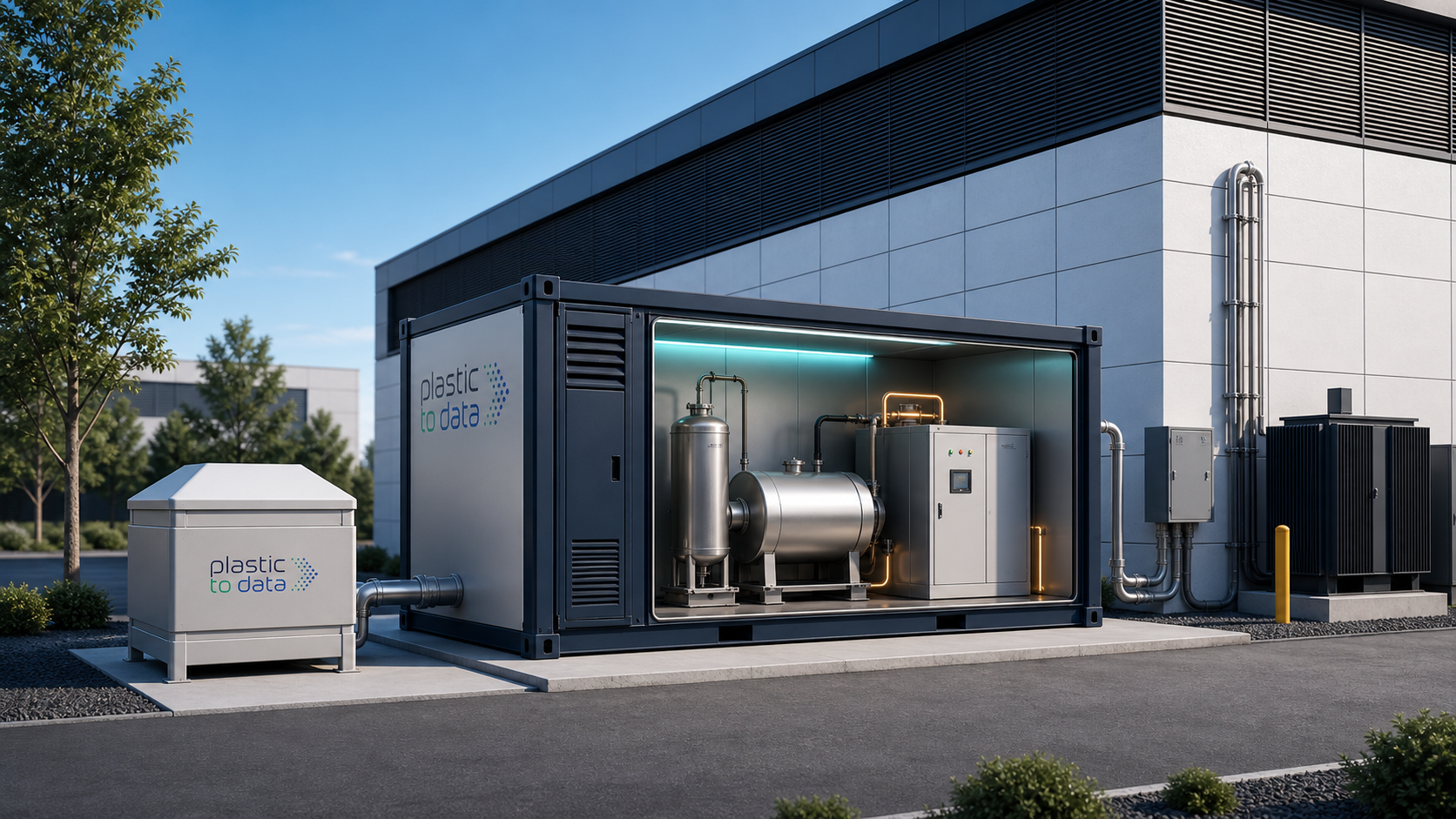
Container-sized equipment is designed to convert residual plastic into fuel for onsite power generation.
The system is designed around integration with existing site power equipment, controls, safety, and interconnection constraints.
The system is designed to support onsite electricity near demand, with site fit shaped by host infrastructure and power needs.
Power is targeted near demand where interconnection timing, resilience, or capacity constraints create deployment pressure.
Pilot
Our next milestone is a practical pilot designed to assess feedstock handling, conversion operation, power integration, emissions profile, controls, economics, and site fit before broader deployment decisions.
Investment Logic
Plastic to Data links low-value local plastic with demand for resilient onsite electricity through container-sized deployments designed around existing power infrastructure and aligned site partners.
Integration with existing infrastructure may reduce the need to wait for entirely new greenfield infrastructure.
Container-sized units are intended to support repeatable rollout once site fit, feedstock supply, and local operating requirements are demonstrated.
The system is designed to convert local waste plastic into onsite electricity. Where it displaces diesel generation, it avoids emissions from that displaced diesel use.
Project economics depend on locally available feedstock, host-site infrastructure, and demand for timely power.
Team
Plastic to Data combines technical execution, partner development, and community engagement to align the right site, feedstock, power, and capital partners around a practical solution.
Chief Executive Officer
Co-Founder
Chief Technology Officer
Co-Founder
Chief Science Officer
Co-Founder
Contact
The plastic waste problem is not new. Plastic to Data is bringing the right team and partner network together to supply local resilient power with local residual plastic.
For capital partners evaluating the pilot pathway, commercialization plan, and milestone evidence.
Request Investor MaterialsFor power facilities or constrained sites with infrastructure, load pressure, or container-sized pilot interest.
Discuss Pilot FitFor municipal, commercial, or industrial residual plastic streams that need a higher-value local pathway.
Explore PartnershipFor data center, microgrid, or constrained-grid users evaluating local electricity options.
Contact the Team